If somebody in your home actively searches:
- your room;
- your drawers;
- your phone;
- your packages;
- your laundry;
- your accounts
then “hide it better” may not be a real answer.
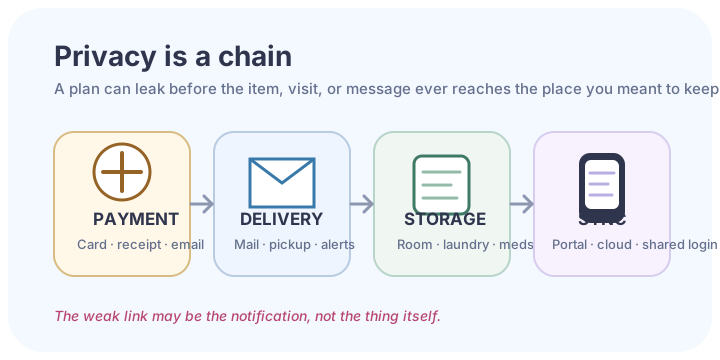
The privacy chain
Start here
Where can the thing leak?
A plan can fail before the item ever reaches your room.
Buying
Shared cards, shopping accounts, email receipts, browser history.
Delivery
Package alerts, early delivery, family opening mail.
Storage / use
Room searches, laundry, photos, makeup, packaging.
Digital trail
Cloud photos, shared devices, notifications, saved passwords.
If your room gets searched
Do not keep escalating to increasingly elaborate hiding spots without asking:
“What happens if they find it again?”
If discovery could mean:
- violence;
- housing loss;
- medication loss;
- phone confiscation;
- financial punishment
the lower-risk choice may be delaying the purchase or storing something outside the home with a trusted person who explicitly agreed.
If packages are the weak point
Possible lower-risk options depend on what is available to you:
- store pickup;
- parcel lockers;
- delivery to a trusted person who agreed;
- buying in person;
- choosing items that do not create an obvious package.
Do not rely on a fake emergency or complicated story if a boring purchase can solve the same problem.
If your phone gets searched
Check:
- lock-screen notification previews;
- saved photos;
- recently deleted photos;
- cloud photo sync;
- shared Apple/Google accounts;
- browser tabs/history;
- app notifications;
- shared password managers;
- email receipts;
- shopping apps.
A hidden app icon does not help if the account sends an email.
If your laundry is monitored
Some clothing is easy to hide until it has to be washed.
That is part of the plan.
Ask:
- Can I wash it myself?
- Can I hand-wash it safely?
- Does it need special care?
- Where does it dry?
- Who notices missing laundry?
If the answer is “there is no private way to wash or store it,” that is worth knowing before you buy it.
If one family member is safer
You may have more options through them.
Try:
“Can you hold something private for me and not tell anyone else?”
Only use that if they have already shown they can keep something private.
If you are discovered
See My Parents Found My Clothes. What Do I Say Right Now?.
Bottom line
If somebody repeatedly searches your belongings, the problem is not that you have not found a sufficiently genius hiding place.
The environment itself has low privacy.
Plan around that reality.