You do not have to prove that somebody is dangerous before you leave.
Sometimes the signal is much smaller:
this is not the plan I agreed to.
Start here
What changed?
Any one of these can be enough to stop the meetup.
Different person
They look substantially different, someone else answers the door, or the identity does not match what you expected.
Extra people
A spouse, friend, watcher, or participant appears who was never part of the plan.
Different location or substances
The address changes, you are pushed toward a second location, or drugs/alcohol suddenly become part of the plan.
Nothing obvious — it just feels wrong
You cannot point to one dramatic fact, but you want out.
Different person
Maybe the photos were old.
Maybe the person is not who they said they were.
Maybe somebody else answers the door and says:
“Oh, he is inside.”
You do not have to enter to investigate.
You can say:
“This is not what I expected. I am leaving.”
If you are still outside or in a public place, stay there while you arrange your ride.
Extra people
A one-on-one meetup becoming:
- a spouse watching;
- another person joining;
- a group;
- an unexpected roommate who is involved;
- a “surprise” kink scenario
is not a small detail.
Even if you might have agreed under different circumstances, you did not agree to it before arriving.
You can leave.
You do not owe them a negotiation because you already traveled there.
The location changes
You planned for:
their apartment
and now they want:
a hotel / car / second house / back room / another person’s place.
That is a new decision.
If you want the new plan, make it consciously.
If you do not:
“No, I am not changing locations. I am heading home.”
Do not let “we are already here” become the reason you keep going.
Substances suddenly become part of the plan
If you agreed to a sober meetup and arrive to find the other person heavily intoxicated, using drugs, or pushing you to take something, the situation changed.
You can leave even if they are friendly.
You do not need to wait until they become aggressive.
If you choose to stay, keep control of what you drink or take and do not accept an unknown substance based only on somebody’s description of it.
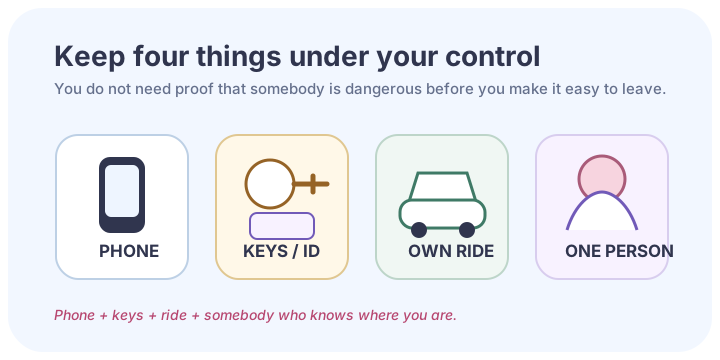
They want your phone, keys, or ID
Do not hand over the things you need to leave.
Your phone, keys, ID, payment, medication, and transport access should stay where you can reach them.
If somebody insists on holding one of those things, that is useful information.
They keep trying to make the new plan sound normal
Examples:
“Relax, my boyfriend just wants to watch.”
“Everybody does this.”
“You came all this way.”
“I thought you were adventurous.”
“Don’t be weird.”
None of those sentences turn a new plan into the plan you agreed to.
Use the words
You can use one sentence
You do not need to win the argument.
This is not what we agreed to. I’m leaving.
No. I’m not changing the plan.
I’m not comfortable anymore. I’m going home.
Something came up. I have to go.
If being direct feels unsafe
You are allowed to use a boring excuse.
You are not under oath.
Try:
- “My ride is here.”
- “I have to take this call.”
- “I’m feeling sick.”
- “My friend needs me.”
- “I forgot something important.”
The goal is leaving.
You can give the honest explanation later, if you ever want to.
If you need help getting out
Move toward:
- staff;
- security;
- cashier;
- bartender;
- front desk;
- other customers;
- a well-lit public area.
Say:
“I am with someone and I am uncomfortable. Can I wait here while I get a ride?”
or:
“Can you help me leave without the person I came with following me?”
You do not need to explain your sexuality or what kind of meetup it was.
If they physically stop you from leaving
If somebody:
- blocks the door;
- takes your phone or keys;
- threatens you;
- restrains you;
- follows you after you have clearly left
move toward other people and get emergency help if you can safely do so.
At that point, stop worrying about whether you are being rude.
If nothing bad happened after all
Good.
You still did not make a mistake by leaving.
The standard is not:
“Was this definitely a trap?”
The standard is:
“Was this still the situation I chose?”
You are allowed to leave a harmless situation you do not want.
That is what having an exit is for.
Before the next meetup
Make leaving easier before you arrive:
- use your own transportation;
- tell one person where you are;
- keep phone / keys / ID / payment accessible;
- decide one non-negotiable boundary;
- avoid giving a stranger control of your only ride;
- keep the first meeting boring enough that you can reassess in person.
For the broader plan, see Online Safety Basics.
This page provides general safety information. If somebody is preventing you from leaving or there is immediate danger, use local emergency services if you can safely do so.