If women’s sizing makes you feel like you suddenly forgot how clothes work, that is not you.
A men’s medium does not reliably convert to one women’s size. Different brands can use the same label for very different measurements, and even two items from the same brand may fit differently.
Stop translating labels and start using measurements.
The measurements worth knowing
You do not need twenty numbers.
Start with:
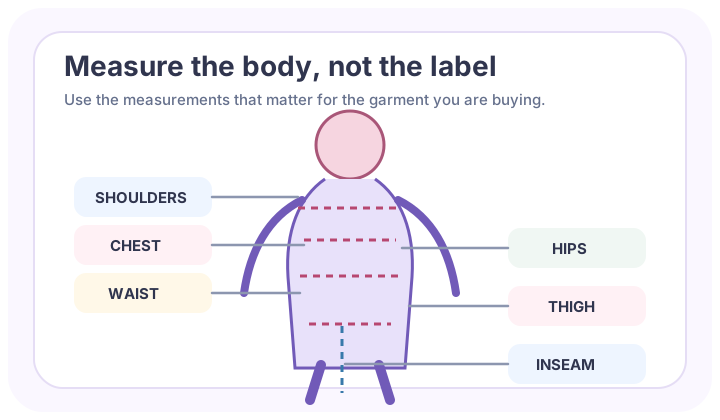
- chest — around the fullest part of your chest;
- waist — around the place the garment will sit;
- hips — around the fullest part of your hips/seat;
- inseam — crotch to ankle for pants;
- shoulders — especially for fitted tops, jackets, and dresses;
- thigh — especially for fitted shorts, stockings, and thigh highs.
A soft measuring tape is easiest.
If you do not have one, use a piece of string or ribbon, mark the length, then measure that against a ruler.
Do not suck your stomach in or pull the tape tight enough to change the number. You are trying to buy clothes that fit the body you are actually putting them on.
Choose your priority
Label size vs. actual measurements
Guess from S / M / L
Fast, but unreliable across brands, cuts, fabrics, and body proportions.
Use the item’s size chart
Compare the measurements that matter for that garment and start from the largest relevant one.
The label is a shortcut. The measurements are the information.
Stop asking “what women’s size am I?”
Ask:
“What size am I in this specific item?”
Open the product’s size chart.
Compare your measurements.
If your waist says medium but your hips or shoulders say large, start with the measurement that matters most for that garment.
For example:
- skirt: waist and hips;
- fitted shorts: waist, hips, thighs;
- pants: waist, hips, inseam;
- fitted shirt: chest and shoulders;
- loose sweater: chest and desired length;
- thigh highs: thigh circumference and actual length.
If one important measurement falls into a larger size, the larger size is often the safer starting point.
I am tall
Sizing up does not always fix length.
A larger standard-size skirt, shirt, or pair of pants may get wider without getting long enough.
Look specifically for:
- tall sizing;
- long inseams;
- garment length in inches or centimeters;
- customer photos/reviews from people near your height.
For thigh highs, check the actual sock length instead of trusting the words “thigh high.” Something designed to reach mid-thigh on a 5'4" model may be a knee sock on you.
I am broad or built pretty straight
Women’s clothing is often cut with assumptions about shoulder, waist, hip, or chest proportions that may not match you.
That does not mean you need a different body.
It means the garment was drafted for different proportions.
Useful fixes include:
- size for shoulders/chest in structured tops;
- choose stretch fabrics when you want closer fit;
- use belts or adjustable waists when the waist ends up loose;
- choose A-line or pleated skirts when you want less dependence on hip shape;
- look for garments that list real measurements instead of only S/M/L.
The label says “femboy” and it still fits terribly
That happens.
A product being marketed to feminine men does not guarantee it was patterned around male-typical proportions.
Trust the measurements, not the category name.
I want to buy my first few things without wasting money
Do not buy an entire wardrobe before you know what fits.
A useful first test is:
- one inexpensive bottom;
- one top;
- one forgiving item with stretch or an adjustable waist.
Try them.
Write down what worked:
Brand — item — labeled size — how it fit.
After a few purchases, your own notes will beat a generic conversion chart.
Shopping in person makes me nervous
You do not need to explain what the clothes are for.
You can walk in, pick something up, pay for it, and leave.
If you need help, ask:
“Can you help me figure out the measurements on this?”
Not:
“Can you tell me whether I am allowed to wear this?”
If trying things on feels like too much, buy somewhere with a return policy you understand and test the fit at home.
I cannot have the purchase found at home
The privacy problem starts before the clothes reach your bedroom.
Think through:
- payment record;
- shared shopping account;
- email receipt;
- delivery address;
- package notifications;
- who gets the mail;
- where the item will be stored;
- who does laundry;
- whether photos sync to a shared cloud account.
If somebody in your home actively searches your belongings, a clever hiding spot may not solve the real problem.
Sometimes the lower-risk option is:
- waiting;
- buying something subtle enough to pass as ordinary clothing;
- using clothes you already own differently;
- keeping an item with a trustworthy person who has actually agreed to that.
See Identity & Coming Out Resources for the broader family/privacy plan.
Bottom line
Measurements beat labels.
If the clothes do not fit, that is information about the clothes.
It is not a verdict on your body.