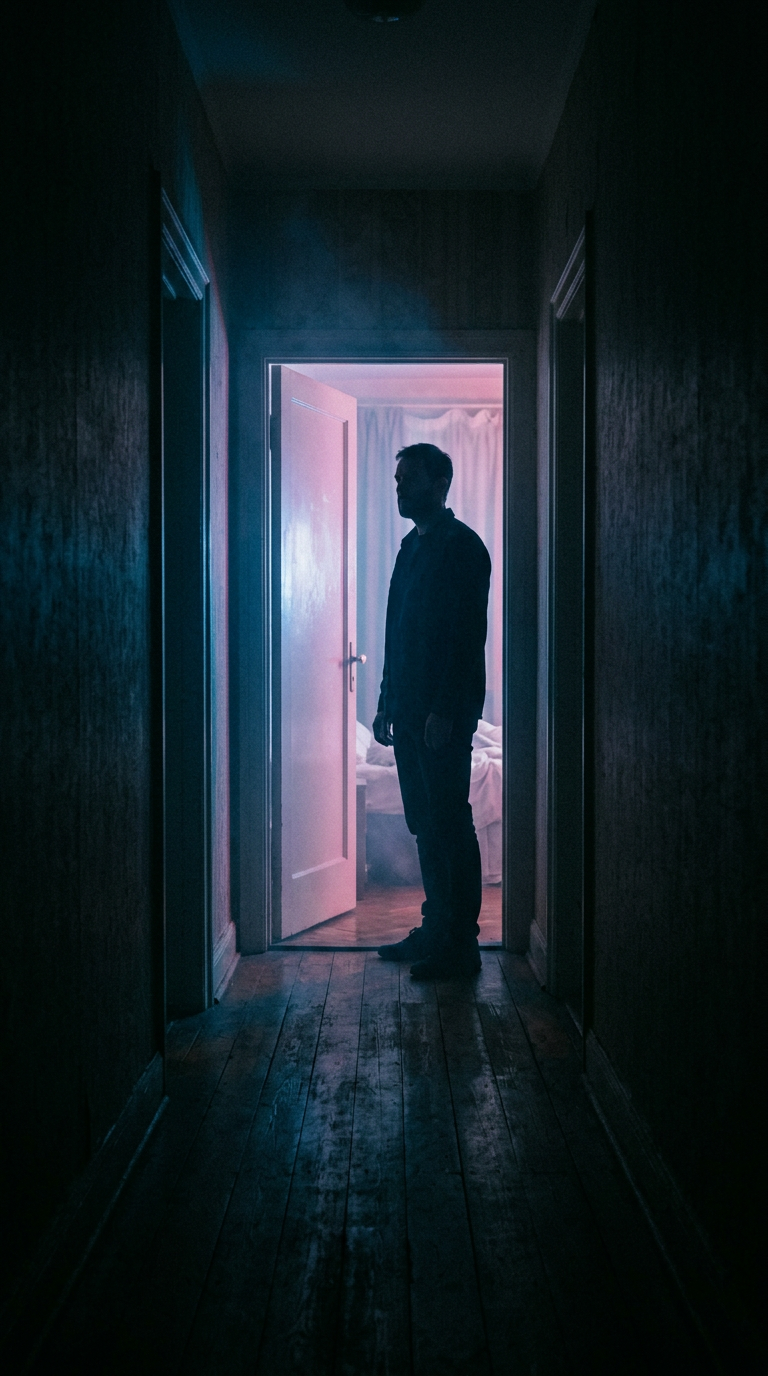
Last Ride
By Archive Remix | 25 Aug 2026 Source: The Archive remix — original, straight-guy hookup set
Synopsis: 11:40 p.m., a long route I chose on purpose, and a straight driver who has never once wanted to end a ride early. Two weeks later I texted his number. He was right about one thing: the last ride was the first one that mattered.
I’m looking at the app screen the way other people look at horoscopes.
11:40 p.m. The bar on Fillmore closed twenty minutes ago, the bouncer is on his third round of turning people out into the cold, and my dress is doing that thing where the lace at the hem keeps catching on the doorframe every time I lean against it. Soft pink. Not a lot of it. Enough.
Nico, twenty-four, freelance illustrator, currently worth less than a glass of the house red he’s been drinking for an hour. It’s not the dress that keeps my shoulders up. It’s the fact that I don’t know what I’m doing.
I’ve done the math all evening. I know exactly what I’m doing, which is the problem, because the math says I should be home by now, decompressing, ordering the toast that doesn’t come until 1 a.m. The math says the night is finished. The night is not finished.
I tap request.
The car is a dark grey sedan, new enough that it still smells like the factory sealant, old enough that the radio still has real buttons. He pulls into the curb like he’s parked there all week, which, in a way, he probably has. I open the door, slide in, and the smell hits me first: coffee, cold air, and something clean, like laundry that’s been ironed.
“Evening, ma’am.”
The word lands soft. Not a joke. Not a test. Just the word he uses on the clock.
“Evening.”
“Where to?”
I tell him my street. He’s already rolling. The meter’s ticking. Behind the little plastic strip that says his rating, I can see the years of him in the way his hands hold the wheel — ten and two, palms loose, like the car is a dog he’s been walking a long time.
“You work nights?” he asks, after a block.
“Freelance. Which is what I tell people when they ask why my schedule looks like a puzzle.”
He almost smiles. “Puzzle people. Yeah. I get those.”
That’s the thing. He doesn’t flinch. Most guys at 11:40 with a woman in pink lace in the back seat either make it about the dress or make it about the androgyny of it, or make it about nothing at all, and all three versions are a door closing. He makes it about nothing, which is a door staying open, and I notice myself making a list in my head. Coffee breath. Loose hands. The way he checked the mirror twice before pulling out, not because I was the reason, because it’s how he drives.
The thing about the route is this: the app gave me three. Shortest was nine minutes. I swiped the other one. The long one, over the bridge, down by the water, the one that adds twenty-two minutes and a view of the city going gold in stages. I swiped it before I got in the car. I’ve been thinking about that swipe for the rest of the night, because it’s the first honest thing I’ve done in weeks, and I can’t tell if it was courage or just the red wine.
“You quiet most of the time?” he says, somewhere around minute six.
“Only on the long routes.”
Another almost-smile. “That’s fair.”
We do a kind of nothing for a while. He tells me he’s been driving for six years, mostly nights, because his body was done with the job that made it night shifts in the first place, and I tell him the truth, which is that I draw for a living and I’m tired and I like the way the water looks when the city is on the other side of it. I talk to him the way I talk to strangers, which is more honestly than I talk to most people I’m not strangers to.
At minute nineteen he says, very quietly, “I should tell you something, and you don’t owe me a single thing for the rest of the ride.”
I don’t turn around. I look at the water. “Go ahead.”
“Six years. Two or three thousand rides, I lose count. And I have never once — not one time — wanted to end a fare early. You’re the first person I’ve ever wanted to sit with longer than the fare.” He pauses. “I’m a straight man. I’m telling you that because it’s the truest thing in this car right now, and because you deserve to know who’s saying it before I say anything else.”
My hands are in my lap. My hands have been in my lap since minute two.
“And the anything else is?” I ask. My voice comes out steadier than I feel.
“It’s that I have a number on this dash that’s not the app’s number.” He taps the plastic once, gentle, like a dog again. “If you ever want a ride home that isn’t a ride home, it’s in the notes on your phone, under D, if the app saved it. I typed it slow on purpose.”
The meter stops. My street. The curb. The city doing its gold thing through the windshield.
I don’t move. He doesn’t either. The engine idles with that low hum that’s the only sound.
“Twenty-two minutes,” I say. “You got me home in forty-one.”
“Yeah.”
“That was on me.” I turn to him then. “The swipe. Not the part where I made you sit here. That was on me, too. Both of it. I chose this route, and I chose to stay in the seat past the stop sign. You should know that.”
He looks at me. Not at the dress. At me. “You know what? I think I should.”
I get out. The cold takes my face. The car pulls away before I’ve finished the door, and I stand there in the pink lace and the sheer stockings on the corner of my street, holding my phone, where under D is a number and a name and a driver’s rating and the whole rest of my life.
Two weeks later I text it.
One word: Nico?
Three dots. Four seconds. You the one from the long route?
I’m the one from the long route.
The number texts back: There’s coffee on. It’s 1 a.m. coffee. It’s the good kind. Come over?
I’m at his door in eleven minutes, because I planned it the way I planned the swipe, because I have been doing the math since that night and the math finally stopped being math.
His apartment is the same as his car. Coffee, clean laundry, something that smells like the start of a day. A cat the size of a furniture complaint watches me from the sofa like he owns the place, which he does.
“Close the door, ma’am,” he says.
And I do.
“First thing,” he says, with both hands on his coffee, standing in the middle of his kitchen like he’s about to give a speech. “I said it in the car and I’m going to say it again, because you deserve it said by a man with his shoes on. I’m straight. I’ve been straight my whole life. I have an ex-girlfriend and a mother and a life that is built out of straight, and none of that is a joke.”
“None of it’s a joke,” I agree.
“Second thing. I have no idea what this is. I’m not going to pretend I do. I’m going to tell you what I know, which is: you’re the only person I’ve ever sat with longer than the fare, I’ve been thinking about that ride for fourteen days, and I would rather be honest about not knowing than clever about it.”
I set my bag down. I take off my shoes. The lace hem catches on the doorframe again, and this time I let it.
“Third thing,” he says. His voice is doing something quiet. “The car was parked. The meter was off. The door was unlocked. Everything I control is under control. The rest of it was yours. It’s still yours. Everything in here is yours. The door, the coffee, the seat. If you say no, I make you coffee and you tell me about the toast that comes at 1 a.m., and I am still your driver, and the number stays saved.”
I’ve been held that way before. Being handed the lock. It’s rarer than you’d think, and it’s the only key I answer.
“Okay,” I say. “Here’s what I know.” I take his hand. He lets me. His palm is warm and rough and steady, ten-and-two hands, and when I press my thumb into the center of it he goes very still, the way people go still when something true is being confirmed. “I swiped the long route. I didn’t swipe it for the water. I swiped it because I knew I was going to want to stay in that seat, and I wanted you to have the whole night to be honest with me, because I needed to hear the words from you, not from a rating on a dash. So you didn’t make this happen to me. You made it possible, and I drove it.”
Something in his face breaks open, just a little, like a windshield in cold weather.
“Okay,” he says.
I kiss him standing up, because the sofa had the cat in it, and the cat had an opinion.
We do not move fast. That’s the thing people would get wrong about it if I told them: it’s slow, and the slowness is the whole point. He learns my body the way he learned the long route — by not rushing it, by knowing that the good part is the driving and not the arrival. I learn his the same way. He talks through it the way he did in the car, quiet and steady and true. This is new. This is you. Tell me when. And every time he asks, the answer is the same, and every time I give it, he listens like it’s a navigation instruction he intends to follow.
At some point I realize I’m not performing. That’s the word. For a long time, being wanted by a straight man was a performance I did at a high level — the dress, the voice, the timing, the list of things not to do so the magic doesn’t break. In his kitchen, in the quiet, with the cat asleep on the radiator and the coffee gone cold, I am not performing. I am a boy in a pink dress being held by a man who said the truest thing in the car out loud, and the magic does not break. The magic is what’s holding.
Later, on the sofa, with the cat wedged between us like a contract, he’s looking at the ceiling and saying, “I should call you something other than ma’am by now.”
“You can call me ma’am.”
“I’m going to call you Nico.”
I consider that. “It’s not a bad start.”
He turns his head. In the dark the room is all gold from the streetlight, and he looks at me the way the city looks from the long route — like he’s seen the whole of it, and like he wants to see the rest.
“I have a question,” he says.
“Ask it.”
“Next time you ride with me, is it still a fare?”
I pick up the cold coffee. I drink what’s left.
“It’s a date,” I say. “And I’m not paying.”
He laughs, quiet, the first real laugh I’ve heard from him, and the cat shifts, and the city goes gold outside the window, and I’m thinking about how the math was right all along — how the short route was nine minutes, and the long one was forty-one, and the difference between them was a number under D, and a man who told the truth with his shoes on, and a door that was always, in the end, on my side.
I didn’t swipe the shortest route.
I never do.